Janet Cardiff and George Bures Miller: The Killing Machine and Other Stories 1997 – 2005

Janet Cardiff The Killing Machine
Janet Cardiff and George Bures Miller: The Killing Machine and Other Stories 1997 – 2005
Miami Art Museum and Freedom Tower, October 21, 2007 – January 20, 2008
The first exhibition in the museum’s new collaboration with Miami Art Central (MAC@MAM) Janet Cardiff and George Bures Miller: The Killing Machine and Other Stories 1995-2007 premieres on October 21, 2007, and remains on view through January 20, 2008. This exhibition is presented in two locations: the Miami Art Museum and Freedom Tower, both in downtown Miami.
Since the early 1990s the Canadian artists Janet Cardiff (b. 1957, Brussels, Ontario) and George Bures Miller (b. 1960, Vegreville, Alberta) have collaborated on works that take sound and voice as both raw material and subject. Through the reproduction and editing of binaural sound, and the use of headphones and speakers, these works can truly be characterized as sound sculptures. Cardiff and Miller’s installations combine fictional stories with sound effects, becoming lived experiences for the visitor. Their audio narratives call into question what our senses tell us, opposing hearing to sight. They transform sculptural space into a phantasmagorical or hallucinatory one, where apparently contradictory cultural traditions collide at a specific place and time. It is difficult to categorize these works, which collage together high culture—including opera, art films, and literature—with pop culture forms, such as B movies, rock ’n’ roll, and radio broadcasts.Their installations also unite forms of high culture such as opera, German Expressionist cinema and French New Wave films with popular culture, such as B-movies, rock and roll and radio broadcasts.
In addition to their collaborations, both artists work separately, and the exhibition includes examples of individual productions by each artist. The Killing Machine and Other Stories 1995-2007 includes ten installations that weave a fabric of independent but complementary experiences. Each work imposes a time and a rhythm of its own, and, like a play, is linked to the imaginative capacity of each member of the audience, giving rise to a host of readings. Cardiff and Miller’s work comes close to literature in its generation of a script that can be read or interpreted in various ways, according to the eye or ear of each reader-spectator. This produces stories that live side by side in time and transport the visitor to superimposed fictions, not only of the works, but of the museum itself.
This exhibition marks the premiere of the titular piece, which is based on Franz Kafka’s story “In the Penal Colony.” Cardiff and Miller’s The Killing Machine (2007) reflects on the death penalty in the United States. While the work seems to invite the spectator to approach it, it also arouses a feeling of rejection. Also on view will be The Paradise Institute, created for the Canadian Pavilion at the 2001 Venice Biennale, which won the Biennale di Venezia Special Award and the Benesse Prize. In this piece, the artists further investigate perception and the viewer’s immersion within the work. The viewer enters a fictitious cinema with two rows of seats and a bird's-eye view of a model of a large movie theater. When he or she puts on headphones, the movie begins. The film is a blend of thrillers, crime, science fiction, and experimental genres, with an imaginary audience superimposed on the soundtrack. Fiction and reality mingle as absorption in the film ends and other stories come into play.
Opera for a Small Room (2005) is based on the perhaps real, perhaps fictitious figure of R. Dennehy, an opera record collector who lives or lived in Salmon Arm, British Columbia. Cardiff and Miller purchased his collection of signed records and created a story based on his obsession with collecting. The piece features the room where Dennehy would listen to his records. Spectators cannot enter the room, but through a system of record players, lights, speakers, and sound effects, they can experience the drama of his obsession and its possible denouement. Forty-Part Motet (2001) presented at the Freedom Tower, translates an experience of music into one of space; the music, a sixteenth-century choral work—Spem in Alium by English composer Thomas Tallis, written in 1575—is sung by forty voices. Tallis organized the motet in eight groups of five voices each, and each group includes four adult male voices (bass, baritone, alto, and tenor) and a boy’s voice (soprano). Each voice is broadcast over an individual loudspeaker that has been “humanized” to allow the spectator to feel the physical presence of each singer.


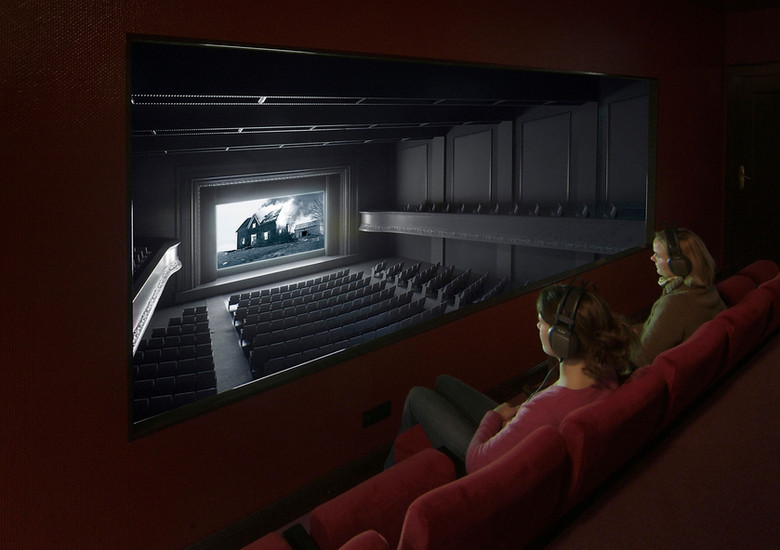


Photo Credits
Janet Cardiff – George Bures Miller, The Dark Pool, 1995. Mixed media audio installation. Courtesy Galerie Barbara Weiss, Berlin.
Janet Cardiff – George Bures Miller. Opera for a small room, 2005. Mixed media audio installation. Courtesy Galerie Barbara Weiss, Berlin.
Janet Cardiff – George Bures Miller. Opera for a small room. 2005. Mixed media audio installation. Courtesy Galerie Barbara Weiss, Berlin.
Janet Cardiff – George Bures Miller. The Paradise Institute, 2001. Mixed media audio installation. Courtesy Janet Cardiff.
Janet Cardiff – George Bures Miller. Playhouse, 1997. Mixed media audio installation. Courtesy Galerie Barbara Weiss, Berlin.
Janet Cardiff and George Bures Miller. Opera for a small room, 2005 (detail). Mixed media audio installation. Courtesy Galerie Barbara Weiss, Berlin.
Janet Cardiff – George Bures Miller. Opera for a small room, 2005 (detail). Mixed media audio installation. Courtesy Galerie Barbara Weiss, Berlin.
Janet Cardiff – George Bures Miller, The Paradise Institute, 2001 (detail). Mixed media audio installation. Courtesy Janet Cardiff
Janet Cardiff – George Bures Miller. The Killing Machine, 2007. Mixed media audio installation. Courtesy the artists. Photo: Seber Ugarte.
Janet Cardiff – George Bures Miller, The Paradise Institute, 2001 (detail). Mixed media audio installation. Courtesy Janet Cardiff.
Janet Cardiff Freedom Tower.
Janet Cardiff – George Bures Miller. The Killing Machine, 2007. Mixed media audio installation. Courtesy the artists. Photo: Seber Ugarte.
Janet Cardiff and George Bures Miller: The Killing Machine and Other Stories 1995-2007 is organized and co-produced by the Museu d’Art Contemporani de Barcelona (MACBA) and the Institut Mathildenhöhe (Darmstadt, Germany) in collaboration with Miami Art Museum. In Miami, it is a MAC@MAM program is coordinated by Adjunct Curator Rina Carvajal. The Freedom Tower venue is courtesy of Terra Group. Major support is provided by the Cisneros Fontanals Art Foundation in partnership with Porsche Cars North America. Additional support is provided by Terra Group, the Consulate General of Canada in Miami and MAM’s Annual Exhibition Fund.