Victor Grippo: Works 1971-2001
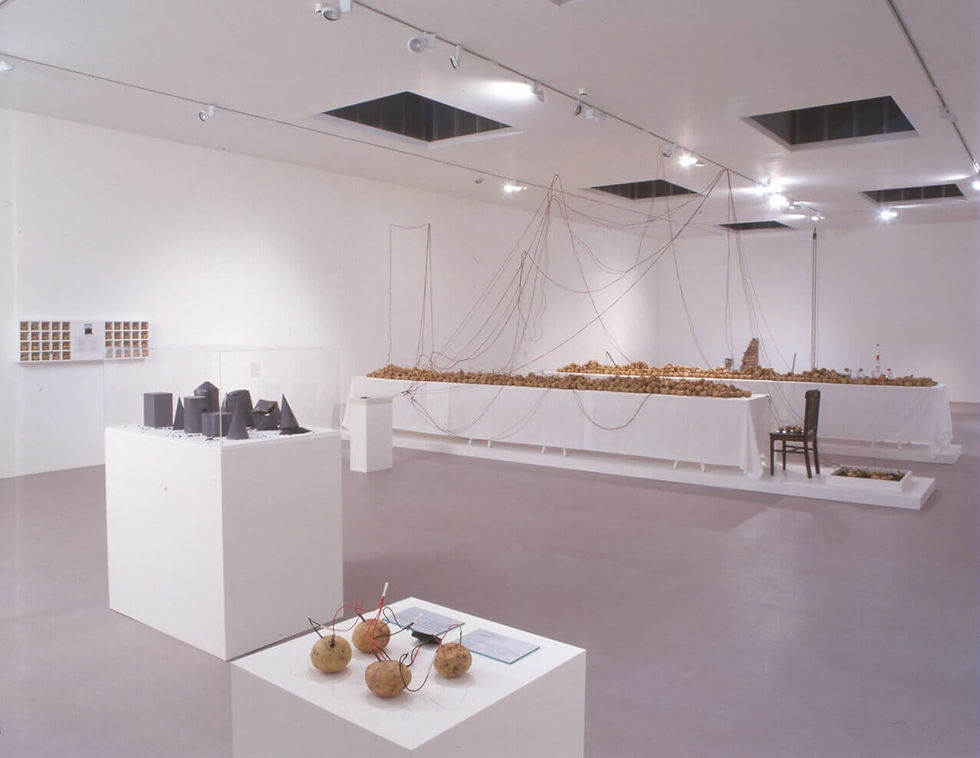
Victor Grippo, Works 1971-2001. Installation view.
Victor Grippo: Works 1971-2001
Miami Art Central (MAC) March 24 to June 18, 2006,
Victor Grippo: Works 1971-2001, the artists first comprehensive exhibition in the United States. Victor Grippo is one of the most influential figures in the history of Argentine art. His artistic universe, a singular blend of conceptualism and alchemy, provokes continuous associations between art, science, and daily life.
From his early training as a chemist, Grippo acquired a fascination with science and experimentation that he incorporated into his artistic practice. He had a particular inclination for the organization of systems and the exploration and modification of phenomena. His investigations, which constantly allude to the transformation of matter and the spirit, manifest the instability and constant movement of things toward new realities. They convert the frugal nature of the most humble, common object into a powerful metaphor for latent energy.
Many of Grippo’s sculptures and installations revolve around the distinct forms, processes, and rituals of nourishment. He employs, for example, the modest, perishable potato to create associations referring to the modification of consciousness, thus seeking to achieve a changed consciousness through a changed material. In the installation Analogy I (1970-77), an extensive configuration of potatoes is placed on tables, platforms, and chairs and connected to electrodes and cables. A voltmeter measures the electrical charge generated by the potatoes. The text that accompanies the piece hints at their ability to metamorphose into different states: from nature to food to consciousness, and, finally, spiritual energy.
Tables also occupy a fundamental place in Grippo’s work. They function both as theme—testifying to the confluence and transmutation of experience and memory—and support. Board (1978) presents a simple, worn table inscribed with text. By describing the use of the table over time the text revives traces of a life: meals prepared and shared with others, work, dreams and hopes, “some drawings, some poems, some metaphysical intention accompanying reality.” In Life-Death-Resurrection (1980), Grippo places beans and water inside geometrically shaped lead containers. Unseen, the seeds germinate and slowly break through the metallic forms that contain them, manifesting powerfully—as do the potatoes and the table—energy and the continuity of life.
Grippo’s transposition of objects of daily life into artistic discourse creates an inexhaustible current of analogies, producing a totally new system of connecting those things “that we see without seeing. . .and which we use without knowing they contain energy.” Much of his work seems to offer a space for reconciliation and passage. Marked by the action of a minimal gesture (an inscription, immersion into water), ordinary objects become charged with meaning, revealing their potential for assimilation and mobility. Operating on multiple levels of experience, the everyday elements chosen by Grippo convey a notion of existence as an ongoing process of erasure and reconstruction.
ABOUT THE ARTIST
Son of Italian immigrants, Victor Grippo was born in Junín, Province of Buenos Aires, in 1936. His major solo shows include those held at Ruth Benzacar Galería de Arte, Buenos Aires (2001); a retrospective at the Ikon Gallery in Birmingham and the Palais des Beaux-Arts in Brussels (1995); Museo de Arte Contemporánea Carillo Gil, Mexico City (1994); Fawbush Projects, New York (1991); Fundación San Telmo, Buenos Aires (1988); Gabinete de Arte Raquel Arnaud, São Paulo (1984); and at Galería Artemúltiple, Buenos Aires (1976, 1980). Most recently, his work has been included in prestigious international exhibitions including: Global Conceptualism: Points of Origin 1950’s-1980’s, Queens Museum of Art, New York (1999); Out of Actions: Between Performance and the Object 1949-1979, The Museum of Contemporary Art, Los Angeles (1998); Art from Argentina 1920-1994, the Museum of Modern Art, Oxford (1994); Latin American Artists of the Twentieth Century, the Museum of Modern Art, New York (1993); and Transcontinental: Nine Latin American Artists, Ikon Gallery, Birmingham (1990). Victor Grippo died in Buenos Aires in February of 2002.
EXHIBITION
Victor Grippo: Works 1971-2001 included 30 works—installations, photographic documentation of urban actions, boxes, and environments, as well as the large-scale installation Mesas de trabajo y reflexión presented in 2002 at documenta 11 in Kassel, Germany. Curated by Marcelo E. Pacheco, chief curator of the Museo de Arte Latino Americano de Buenos Aires (MALBA)-Colección Costantini, this exhibition provides an overdue recognition of this artist. This exhibition was organized by Malba – Colección Costantini, Buenos Aires, Argentina.

1 
2 
3 
4 
5 
1
Photo Credits
Analogy I, 1970/1971, Third versionElectric circuits, electric meter, electric push button, zinc and copper electrodes, potatoes, text, paint, and wood, 47.4 x 156 x 10.8 cm. Collection of the National Museum of Fine Arts, Buenos AiresPhoto: Oscar Balducci.
Analogy IV, 1972, Fourth versionWooden table with three natural potatoes on a Hartford ceramic plate, metal fork and knife on a white linen tablecloth; three carved potatoes in solid transparent acrylic on a plate, knife and fork all made of transparent acrylic resin, on a black velvet tablecloth, 75 x 55 x 100 cm. Private collection. Photo: Oscar Balducci.
Little Baker’s Suitcase (Homage to Marcel Duchamp), 1977Burnt bread treated for preservation, mounted on a polished aluminum alloy rod, in painted wooden and acrylic box with metal handle; bronze plaque with engraved texts on front and back. 32.5 x 51 x 20 cm. Private collection. Photo: Oscar Balducci.
Table, 1978 Sanded wooden table, artist’s text written in permanent black ink; black-and-white photograph on chlorobromide paper, 100 x 79 x 54 cm. Private collection. Photo: Oscar Balducci.
Analogy I, 1970/1971, Third versionElectric circuits, electric meter, electric push button, zinc and copper electrodes, potatoes, text, paint, and wood, 47.4 x 156 x 10.8 cm. Collection of the National Museum of Fine Arts, Buenos Aires. Photo: Oscar Balducci.
In Miami, Victor Grippo: Works 1971-2001 was coordinated by Rina Carvajal, MAC’s Executive Director. This presentation was sponsored by the Cisneros Fontanals Art Foundation. Additional support is provided by the Miami-Dade County Department of Cultural Affairs, the Cultural Affairs Council, the Mayor, the Miami-Dade Board of County Commissioners, and the Cowles Charitable Trust.