William Kentridge
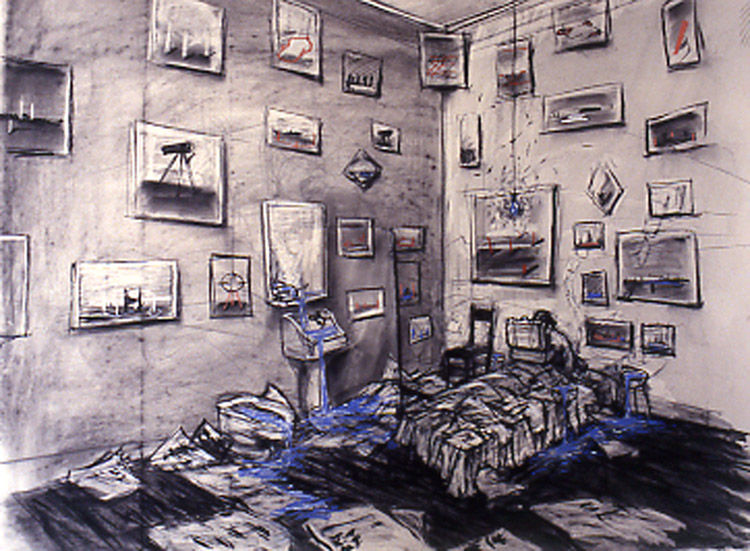
William Kentridge. Felix in Exile, 1994. Animated film. 16 mm film, video and DVD transfer. Courtesy of the artist.
William Kentridge
Miami Art Central, November 30, 2005 – March 5, 2006
William Kentridge presents a comprehensive overview of the work of one of the most compelling and influential contemporary artists working today. A native of Johannesburg, South Africa, Kentridge has developed a distinctive body of work that merges drawing, animation, theater, film, and installation into a practice that is at once intensely personal and politically resonant. His work probes the fault lines of history and memory, offering a poetic and often satirical investigation of South Africa’s social and political landscape during and after apartheid.
At the core of Kentridge’s practice is a unique approach to animated filmmaking. Using charcoal drawings that he repeatedly erases and reworks, Kentridge films each state of the drawing frame by frame, allowing the ghosts of previous images to remain visible. This process produces a moving image that records its own making—drawing attention to the instability of memory, the residue of time, and the fragility of truth. His recurring characters, Soho Eckstein and Felix Teitlebaum, serve as alter egos who navigate the emotional and moral complexities of their environment, oscillating between power and vulnerability, repression and desire.
The exhibition at Miami Art Central includes works spanning from 1979 to 2004, emphasizing Kentridge’s commitment to exploring the intersections of image, narrative, and political consciousness. A centerpiece of the show is Tide Table (2003–2004), a deeply introspective film that revisits the character of Soho Eckstein in a reflection on illness, vulnerability, and the failures of empathy in the face of social inequality. The exhibition also features a selection of early and recent charcoal drawings, animated films, and sculptural installations such as Sleeping on Glass (1999) and Medicine Chest (2000), in which moving images are projected onto everyday objects, transforming them into intimate, cinematic devices.
Also included is Journey to the Moon (2003), a short film that draws from both Georges Méliès’ early cinematic experiments and Kentridge’s own studio rituals. The work speaks to his ongoing fascination with the artist’s process as a metaphor for memory, invention, and the passage of time.
Beyond the screen and page, Kentridge’s extensive involvement in theater—as a set designer, director, and collaborator with the acclaimed Handspring Puppet Company—underscores his belief in the collective, performative nature of meaning-making. His projects blur the boundaries between disciplines, inviting viewers to engage not just with the finished work, but with the act of construction itself.
THE ARTIST
William Kentridge (b. 1955, Johannesburg) is a globally acclaimed South African artist known for his distinctive fusion of drawing, animation, theater, and opera. Kentridge is best known for his distinctive animated films made through a labor-intensive process of drawing, erasing, and redrawing charcoal scenes. His work probes the complexities of South African history, memory, and identity, offering poetic, often satirical reflections on the human condition.
Kentridge studied politics and African studies at the University of the Witwatersrand and later pursued fine art at the Johannesburg Art Foundation and theater in Paris. He began his career in film and theater, co-founding the Junction Avenue Theatre Company and the Free Filmmakers Cooperative. His breakthrough came with the animated film Johannesburg, 2nd Greatest City after Paris (1989), which launched his renowned “Soho Eckstein” series exploring personal and political themes through hand-drawn animation.
His long-standing collaboration with Handspring Puppet Company led to celebrated multimedia productions such as Woyzeck on the Highveld (1992), Ubu and the Truth Commission (1997), and Il Ritorno d’Ulisse(1998). Kentridge has exhibited widely at major international venues, including Documenta, the Venice Biennale, and MoMA, which organized retrospectives of both his films and visual art.
A finalist for the Hugo Boss Prize in 1998 and recipient of the Carnegie Prize (1999/2000), Kentridge has continued to push disciplinary boundaries with large-scale installations, operatic productions, and public commissions, including a major staging of Mozart’s Die Zauberflöte in Brussels (2005). He lives and works in Johannesburg.

1 
2 
3 
4 
5
Photo Credits
William Kentridge. Tide Table, 2003-2004. 16 mm film, video and DVD transfer. Courtesy of the artist.
William Kentridge. Monument, 1990. 16 mm film, video and DVD transfer. Courtesy of the artist.
William Kentridge. Portage, 2000. 16 mm film, video and DVD transfer. Courtesy of the artist.
William Kentridge. Weighing... and Wanting, 1997. 16 mm film, video and DVD transfer. Courtesy of the artist.
Portrait of William Kentridge. Photo: Oriol Tarridas.
William Kentridge was organized by Castello di Rivoli Museo d’Arte Contemporanea, Rivoli-Torino. The exhibition is curated by Carolyn Christov-Bakargiev. The exhibition in Rivoli was made possible through the generous support of Regione Piemonte, Fondazione CRT, Cameradi di Commercio, Industria, Artigianato e Agricoltura di Torino, Cittá di Torino. In Miami, the exhibition was coordinated by Rina Carvajal, MAC’s Executive Director and Chief Curator. Miami Art Central’s presentation of this exhibition is sponsored by the Cisneros Fontanals Art Foundation. Additional support is provided by the Miami-Dade County Department of Cultural Affairs, the Cultural Affairs Council, the Mayor, the Miami-Dade Board of County Commissioners, and the Cowles Charitable Trust.