In Minor Keys: Latin America at the Center of Venice

Updated: May 1
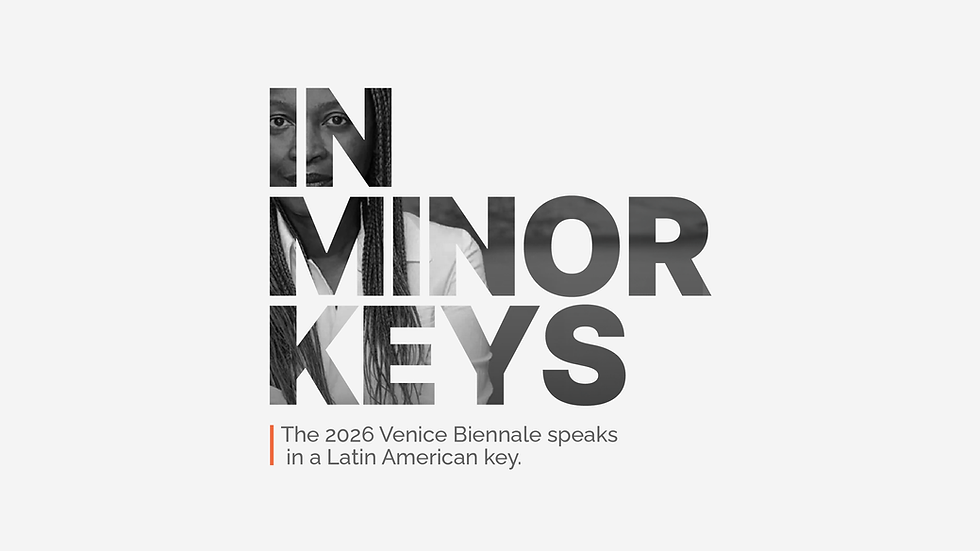
The 61st International Art Exhibition arrives in May with an extraordinary Latin American presence. CIFO reads the signal.
On May 9, 2026, the Giardini and Arsenale in Venice will open their doors to the 61st International Art Exhibition. Its title, In Minor Keys, was chosen by Koyo Kouoh, the Cameroonian-Swiss curator who died in May 2025 before she could see her vision realized. Her team will carry it forward. The exhibition will go ahead exactly as she conceived it. And if the announced artist list is any measure, Kouoh left behind something that deserves to be seen whole.
For CIFO, what matters most in this edition is not a single pavilion or artist. It is the pattern. Latin American artistic practice, long positioned at the edges of the global contemporary art conversation, is now occupying its center. Not as a category to be surveyed. Not as a regional moment to be acknowledged and moved on from. But as a primary voice in the most visible exhibition of contemporary art in the world.
That shift is worth examining carefully. Because it did not happen overnight. It happened because of two decades of institutional commitment, curatorial relationships built one studio visit at a time, and the slow, patient work of building the infrastructure for art to travel, be seen, and be understood across borders.
What Kouoh Built
Koyo Kouoh was the first African woman ever appointed to lead the Venice Biennale. Her death, at 57, cut short a curatorial practice that had spent decades outside the European and North American institutional mainstream, building something more durable than prestige. She founded RAW Material Company in Dakar. She led Zeitz MOCAA in Cape Town. She curated biennials in Ireland and the United States. She knew what it meant to operate from a geography that the art world routinely called peripheral and to refuse that designation.
In Minor Keys was her direct response to what she called the "anxious cacophony of the present chaos." Her curatorial text invited audiences to "shift to a slower gear and tune in to the frequencies of the minor keys" and to listen to what she described as "the songs of those producing beauty in spite of tragedy, the tunes of the fugitives recovering from the ruins, the harmonies of those repairing wounds and worlds." It is a remarkably generous vision for a biennial. And it is one that resonates directly with the concerns that have structured Latin American artistic practice for generations.
Her curatorial materials reportedly drew on Gabriel Garcia Marquez's One Hundred Years of Solitude and Toni Morrison's Beloved as literary reference points. These are not accidental choices. They are a signal about whose stories are at the center of this exhibition.
Brazil: Two Women, One Reckoning
The Brazilian Pavilion, Comigo ninguem pode, brings together Rosana Paulino and Adriana Varejao under the curatorial direction of Diane Lima. The title takes its name from the Dieffenbachia plant, known in Portuguese both as a botanical name and as a popular saying: nobody can handle me, nobody can beat me. The double meaning is intentional. It speaks to toxicity and protection simultaneously. It is a perfect frame for what both artists do.
Rosana Paulino, born in Sao Paulo in 1967, works across printmaking, collage, and installation to trace the histories of slavery and their persistence in Black Brazilian life. Her works are held at MoMA, Tate Modern, and Centre Pompidou. She received the MUNCH Award in 2024. Adriana Varejao, born in Rio de Janeiro in 1964, is known for paintings and sculptures in which viscera appear to burst through the surfaces of Portuguese azulejo tiles. She has shown at Haus der Kunst, the ICA Boston, Fondation Cartier, and Tate Modern. Together, as curator Diane Lima writes, they "represent the most revolutionary aspects of the presence of women in the field of national art."
This is not a pavilion built on safe choices. It is built on the conviction that colonial wounds, examined honestly and with aesthetic rigor, constitute some of the most urgent artistic inquiry of our time. It arrives at Venice in a restored pavilion, following investment by the Fundacao Bienal de Sao Paulo in structural rehabilitation and accessibility upgrades. The infrastructure, literal and institutional, is being rebuilt alongside the argument.
Argentina and Chile: Landscape, Territory, Perception
Argentina is sending Matias Duville to the Arsenale, in a project titled Monitor Yin Yang, curated by Josefina Barcia. Duville covers floors in charcoal and salt, rendering scorched and elemental landscapes that visitors will walk across. There is something deliberately vulnerable about the gesture. The landscape is present but it can be tread on. It does not survive the encounter unchanged.
Chile's pavilion, Inter-Reality, is conceived by artist Norton Maza and curated by Marisa Caichiolo and Dermis Leon. Caichiolo was recently selected to co-curate Chile's official pavilion at this same Biennale while also leading the inaugural Latin American Pavilion at the LA Art Show in January 2026. The Chilean project uses water, sound, and layered perception to examine how local realities collide with global systems. It is, in Caichiolo's framing, "a space of layered perception, where national artistic production becomes a lens for navigating shared planetary concerns."
The Main Exhibition: A Relational Geography
Beyond the national pavilions, the main exhibition itself includes a significant Latin American and Caribbean presence. Among the 110 artists and collectives invited by Kouoh, the announced list includes Maria Magdalena Campos-Pons, the Cuban-born artist based in Nashville, whose performance and installation work has long explored memory, diaspora, and the Afro-Cuban experience. It includes Guadalupe Maravilla, born in San Salvador, El Salvador, who works with healing rituals and community experience in New York. It includes Carolina Caycedo, the Colombian-born, Los Angeles-based artist whose practice centers on water, territory, and environmental justice across Latin America. It includes Eustaquio Neves, from Juatuba, Brazil, who works with photography and appropriation to examine race and Brazilian identity. It includes Ayrson Heraclito, from Macaubas, Bahia, whose practice explores Afro-Brazilian ritual, spirituality, and the legacies of the slave trade. It includes Puerto Rico, with three artists present: Sofía Gallisá Muriente, born in San Juan in 1986, a visual artist and filmmaker whose work explores collective memory and political history; Daniel Lind-Ramos, born in Loíza in 1953, known for large-scale assemblages rooted in Afro-Puerto Rican ritual and community; and Natalia Lassalle-Morillo (in collaboration with Gloria Morillo), born in San Juan in 1991, whose practice engages with embodied knowledge and diasporic experience. Their presence underscores that the Caribbean is not a footnote to Latin American representation here — it is a central voice. And it includes Leonilda González, the late Uruguayan artist born in 1923, whose inclusion is a reminder that Kouoh's relational geography stretched backward as well as forward.
This is not a token presence. It is a structural argument about where contemporary art's most urgent thinking is taking place.
A Debt Acknowledged, A Moment Arrived
For those who have been paying attention, this Venice is not a surprise. It is a confirmation. Latin American artists have been producing some of the most formally rigorous, politically urgent, and culturally searching work in the world for decades. The institutions that recognized this early, that built collection strategies and curatorial relationships grounded in that conviction, are now watching the broader art world catch up.
The question for institutions like CIFO is not whether to celebrate this moment. Of course we do. The question is what responsibility comes with it. Recognition is not the end of the project. It is a new phase. When artists and practices that have existed in relation to a broader indifference suddenly attract significant attention, the pressures they face change. Markets move. Institutions come calling with their own agendas. The risk of flattening individual practices into a convenient regional category becomes more acute, not less.
CIFO's work has always been to hold both things at once: to champion visibility and to insist on complexity. To support the artist, not the trend.
“Artists are channels to and between the minor keys, and listening to, rather than speaking for them, is at the core of the curatorial conceit.” — Koyo Kouoh, Curatorial Text, In Minor Keys, 61st Venice Biennale, 2026.
CIFO POINT OF VIEW
What the 2026 Venice Biennale confirms is something CIFO has argued through its collecting and granting practice for over twenty years: that Latin American artistic practice is not a regional phenomenon waiting for global validation. It is a primary site of contemporary art's most pressing inquiries. Koyo Kouoh understood this. Her selection of artists from Salvador, San Juan, Havana, and Buenos Aires alongside those from Dakar, Beirut, and Johannesburg was not an act of inclusion. It was a structural claim about where ideas are being made.
The risk now is that the art world does what it often does with moments of recognition: converts them into categories, then into markets. Latin American art is not a style. It is not a brand. It is a set of deeply differentiated national and individual practices, shaped by specific histories, specific ecologies, specific political conditions, and specific aesthetic inheritances. Rosana Paulino's Afro-Brazilian feminism is not the same argument as Matias Duville's elemental landscape poetry, which is not the same argument as Carolina Caycedo's environmental and territorial activism. The visibility of one should not be used to flatten the others.
CIFO's institutional responsibility in this moment is to keep providing the close-up view: the individual studio, the specific practice, the single artist's argument with history and form. The biennial offers the wide angle. We offer the depth. Both are necessary if this moment is to produce something more durable than a cycle of attention.
EXECUTIVE SUMMARY
The 61st Venice Biennale, In Minor Keys, opens May 9-November 22, 2026, carrying forward the posthumous curatorial vision of Koyo Kouoh, the first African woman to lead the exhibition.
Latin American and Caribbean artists occupy significant space in both the main exhibition and the national pavilions, with Brazil, Argentina, Chile, Uruguay, El Salvador, Haiti, Puerto Rico and Cuba all represented.
Brazil's Comigo ninguem pode, with Rosana Paulino and Adriana Varejao curated by Diane Lima, is widely viewed as one of the most significant pavilions of the edition, anchored in the examination of colonial wounds and the rewriting of history.
The moment is not a beginning. It is a confirmation of two decades of institutional commitment by foundations, curators, and collectors who recognized Latin American practice's centrality before the broader field caught up.
CIFO's task in this context is to hold the complexity: to celebrate the visibility while insisting on the specificity of individual practices, national contexts, and the artists behind the work.
Comments